
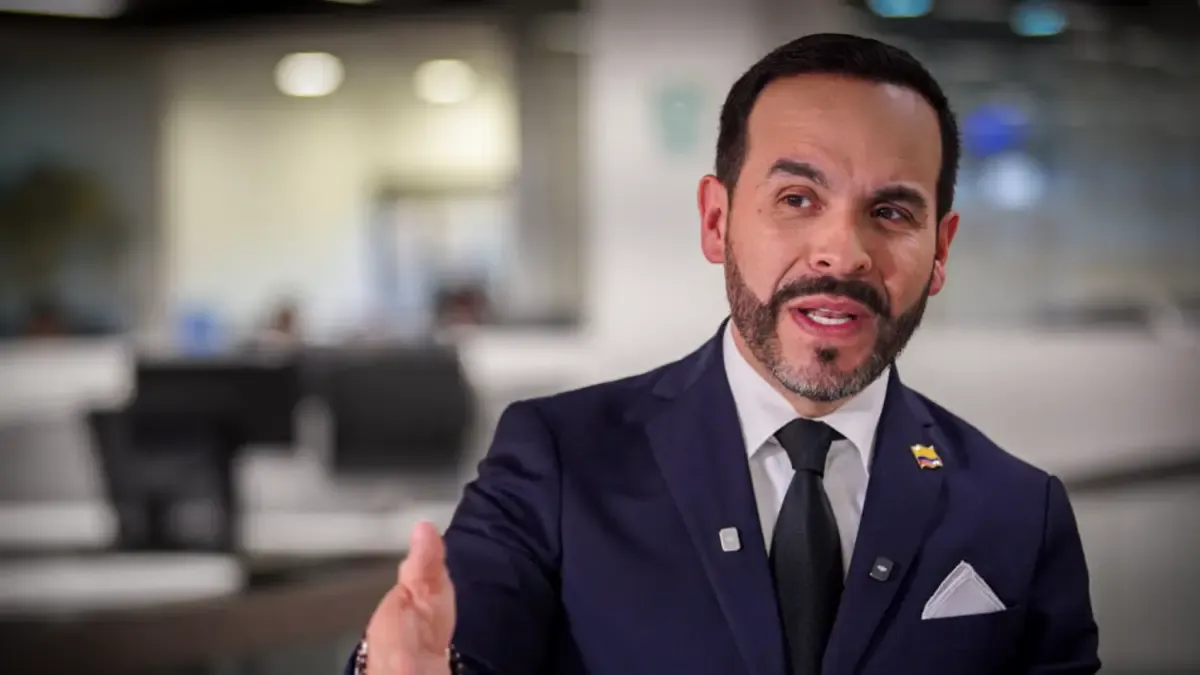
- Opposition leader Iván Cepeda Castro announced a series of penal and disciplinary actions during his first legislative oversight debate.
- Findings from research for the debate will also be submitted to United States authorities, given De la Espriella’s U.S. citizenship.
- Cepeda to file complaint against Abelardo de la Espriella before the House Accusation Commission for criminal conspiracy benefiting drug traffickers and paramilitaries.
- Cepeda to denounce Agriculture Minister Indalecio Dangond for fraud, document forgery, and harassment of peasantry.
BOGOTÁ, Colombia — October 27, 2026 — Senator, opposition leader, and former presidential candidate, Iván Cepeda Castro, presented a series of documentary proofs today during a congressional oversight debate targeting Minister of Agriculture, Indalecio Dangond. Supported by land registry files, public deeds, financial statements, and court rulings, Cepeda Castro argued that state institutions are facing co-optation by an alliance of mafia capital, land ownership, and armed violence—a structural model he dubbed “narco-rentierism” (narcorrentismo).
With this evidence, Cepeda asserted that agencies created “to strip land from drug trafficking and paramilitarism and restore it to victims” are currently run, “in large part, by those who yesterday defended, represented, or did business with those very same sectors,” and who in several cases now make decisions “for their own self-interest.”
According to the evidence presented during the debate, Cepeda exposed a nexus between De la Espriella and drug traffickers that extends beyond an attorney-client relationship into joint commercial transactions and shared corporate entities. These ties, Cepeda stated, are now honored from within the government as De la Espriella acts as a guarantor for narco-paramilitary interests, and not as Colombia’s president.
In that regard, Cepeda noted that the De la Espriella administration, through its Minister of Agriculture Indalecio Dangond, is executing an “agrarian counter-reform” designed to freeze land restitution to peasantry while accelerating the return of confiscated properties to narco-paramilitary networks, thereby altering the rural map in favor of agribusiness projects and multinational energy and mining corporations. This ongoing operation, he argued, completes the trajectory of a government operating at the service of drug trafficking.
Cepeda revealed seven severe cases documenting ten specific acts linking officials to drug trafficking and paramilitarism. He identified the operational machinery of this state capture in the appointment of 14 high-ranking public officials in key agricultural sectors—public servants whose professional records show prior corporate, business, or legal relationships with the private law firm De La Espriella Lawyers and Minister Dangond Baquero himself.
The documents reveal that Abelardo de la Espriella—who became a naturalized U.S. citizen in February 2023—founded the firm Dominio De la Espriella (the commercial distributor of Ron Defensor), a company that received nearly 40% of its capital deposits from the family and business network of Hugues Rodríguez Fuentes, alias “Barbie,” a cattle rancher convicted of drug trafficking and promoting paramilitary groups.
Furthermore, the evidence confirms that Daniel Peñarredonda, a partner at De La Espriella Lawyers until July 2025, is listed as “Co-conspirator 1” in a federal court indictment in Tampa, Florida (U.S.) in a money laundering case alongside kingpin alias ‘Boliche’.
Cepeda also questioned the Ministry of Agriculture’s decision to freeze COP 1.4 trillion pesos allocated for the purchase of peasant land, under the official justification that Colombia has “an excess of land.” While halting rural reform, Dangond’s administration has slashed its budget in half, ordered the removal of the terms “peasant” and “peasantry” from technical regulations, and moved forward with revoking one million hectares of food protection zones to open the land to energy and mining exploitation. “This project seeks to eliminate the peasantry, either by erasing its identity or initially by tolerating aggression against peasant men and women,” Cepeda stated.
Confronting Minister Dangond directly, the opposition leader stated that the official assumed office for the sole purpose of “executing an agrarian counter-reform at the service of land-grabbing drug traffickers and paramilitaries, foreign capital, and the agribusiness and mining companies of his lifelong friends and partners. You came here to destroy the countryside,” Senator Cepeda declared.
“Narco-Rentierism” and the formula for impunity
Opening the debate, Cepeda outlined the state of rural land ownership in Colombia, where the Gini coefficient sits at a critical 0.89, reflecting that 1% of landowners control 50% of the country’s best arable land. The cumulative toll of this historical violence registers, as of December 31, 2025, 14 million hectares forcibly seized or abandoned and over 9 million victims of forced displacement.
To illustrate the mechanics of this phenomenon, Cepeda Castro revisited the stark testimony of former paramilitary commander Jairo Antonio Castillo Peralta, alias ‘Pitirri’: “One group went around killing people, others came behind buying up the land, and others acted as third parties, legalizing it.” Cepeda connected this machinery to the concept of the “narco-bourgeoisie” coined by scholar Nazih Richani, which identifies kingpins who injected illicit funds into the agricultural sector and raised private armies to consolidate a primary accumulation of narco-rentier capital.
From Ralito to head of State: The president’s background
During the debate, Cepeda laid out how Abelardo De la Espriella built his trajectory at the core of this network. While commanders of the United Self-Defense Forces of Colombia (AUC) were negotiating in Santa Fe de Ralito, the current president founded and legally represented the Iniciativas para la Paz Foundation (FIPAZ), an organization accused of receiving funds from paramilitary and drug-trafficking entities.
Senator Cepeda brought historical court records to light:
- In 2008, De la Espriella publicly admitted that he “managed” a group of individuals prosecuted in the parapolítica scandal, including former congressman José de los Santos Negrete, and acknowledged offering his private law offices for the defense of criminal warlords such as Hebert Veloza, alias ‘Macaco’, and Salvatore Mancuso.
- In 2011, the Supreme Court of Justice requested that the Attorney General’s Office investigate De la Espriella after narco-paramilitary Juan Carlos Sierra, alias ‘El Tuso’, accused him of demanding COP 4 billion pesos to “fix” a writ of protection (tutela) before the Constitutional Court, through which AUC bosses sought to be tried for political sedition. The now president admitted to charging ‘El Tuso’ COP 200 million for a legal opinion.
The capture of Mario Iguarán’s Attorney General’s Office and “operation lock”
At the climax of the presentation, the former presidential candidate revisited the mafia capture of oversight agencies. Citing leaked diplomatic cables from WikiLeaks and court confessions, Cepeda presented evidence that alias ‘Macaco’ collected COP 5 billion pesos among AUC leaders to purchase and influence the election of Mario Iguarán as Attorney General in 2005. The criminal objective was to implement an “operation lock” (operación candado) within the Prosecutor’s Office to abruptly halt asset forfeiture proceedings and shield lands confiscated from paramilitaries.
Cepeda Castro demonstrated that this network remains active: during his tenure, Iguarán appointed a business associate and a trusted confidant of De la Espriella to strategic positions. Two decades later, those same individuals have assumed full control over public assets in the current administration: Joaquín Gutiérrez Caballero (former advisor to Iguarán and former presidential campaign manager) serves as President of state oil company Ecopetrol, while Diana Patricia Bravo heads the Special Assets Society (SAE).
The organizational chart of the institutional “revolving door”
Continuing his legislative oversight presentation, Cepeda unveiled what he described as absolute state shielding, executed through the appointment of former members of the firm De la Espriella Lawyers to public agencies with direct jurisdiction over assets seized from their former narco-paramilitary clients:
- Diana Patricia Bravo (President of SAE): Former partner at the president’s law firm and former defense attorney for extradited businessman Alex Saab. From the SAE, she is overseeing the mass return of 138 properties to the family structure of Hugues Rodríguez Fuentes, alias ‘Comandante Barbie’, former financial chief of the AUC in Cesar department and founder of Convivir Salguero Ltda. Additionally, Bravo manages the confiscated empire of cattle rancher José Guillermo ‘Ñeñe’ Hernández (financial partner of “Marquitos” Figueroa, publicly defended by the president), whose COP 480 billion in assets a judge ordered returned in a ruling currently under appeal by the State under case docket 2019-00151.
- Jensy Johana Osorio Porras (Director of the Victims Unit): Former partner at the president’s firm. She controls the Reparation Fund that holds custody over restored rural properties. Her spouse simultaneously serves as Director of the DIAN (Tax and Customs National Directorate), centralizing the auditing of large private fortunes.
- Yoly Beatriz Illidge Pimienta (Delegate Superintendent of Notaries): Ex-wife of President De la Espriella. She directly oversees and inspects all land registrations and annotations issued by restitution judges nationwide.
- Carlos Suárez (Board President of Ecopetrol): Historic defense attorney for Salvatore Mancuso and chief strategist for the current president’s campaign.
- Juan Manuel Noguera Martínez (Director of Land Access at the ANT): The official tasked with determining who receives land allocations under rural reform. Noguera previously served as Secretary of Government in Santa Marta during the administration of Mayor José Francisco ‘Chico’ Zúñiga, who was convicted of criminal conspiracy after entering into contracts with and receiving funding from the AUC’s Resistencia Tayrona Front.
The ten documented facts
- Nueva Jerusalén estate: Business, land, and coal
In 2013, De la Espriella (a U.S. citizen since 2023) acquired the Nueva Jerusalén estate (Becerril, Cesar) from the sister of alias ‘Comandante Barbie’, Hugues Manuel Rodríguez Fuentes, below market price. The property adjoins stolen lands and sits directly atop coal mining titles belonging to multinational corporation Drummond, whose former executives were indicted by the Prosecutor’s Office for financing the AUC’s Juan Andrés Álvarez Front. - Commercial web: Money laundering in Ron Defensor
Cepeda revealed the financial statements of Dominio De la Espriella (the liquor company behind Ron Defensor, currently represented by the president’s sister-in-law), demonstrating that the family of convicted paramilitary Rodríguez Fuentes and their firm Monte Horeb Group contributed 40.8% (2022) and 38.1% (2023) of the company’s monetary capital deposits. - La Alquería property and the judicial circuit of the reparation fund
The La Alquería, Caja de Ahorros (Valledupar), and La América (Chimichagua) properties were part of a cluster of 138 assets seized from Rodríguez Fuentes’ network. A specialized asset forfeiture judge ordered their provisional return, but the National Land Agency (ANT) successfully acquired La América and secured La Alquería for agrarian reform after an AUC member formally surrendered them under the Justice and Peace law. Cepeda reported that peasant families allocated land in La Alquería now face direct threats from Rodríguez Fuentes’ operatives, who warn that “the boss is taking this back no matter what.” The property represents a geo-strategic corridor for coal and narcotics trafficking.
- Polonia estate: The theft of national wetlands
In March 2008, De la Espriella and his father purchased the Polonia hacienda (La Mojana, Sucre) for COP 115 million pesos. The property’s initial title listed only 325 hectares under a “false tradition” legal status, but through a subsequent deed, it was “updated” to 392 hectares—annexing an extra 67 hectares without technical justification, which correspond to public state land (baldíos). GIS cartography from the IGAC (Geographic Institute) proved that the private perimeter encloses 60.9 hectares of the La Hormiga wetlands, public marshes, and floodplains of the Caño Rabón. Constitutionally, wetlands belong to the Nation (Art. 63), and their legal demarcation lies in the hands of the ANT, an agency controlled by the Executive branch. - The real estate transaction with Carlos Arturo Vega Pineda
The documentary dossier reveals a direct 2020 transaction: the president’s family construction company, Cosenza S.A.S., acquired a land lot on the left bank of the Sinú River (Montería) registered under the name of Carlos Arturo Vega Pineda. Vega Pineda is a Córdoba cattle rancher formally under investigation by the Prosecutor’s Office for money laundering following an unjustified increase in wealth. Senator Cepeda revealed that this seller was registered as the owner, between 2000 and 2007, of four rural properties in Unguía (Chocó) that belonged to former Elmer Cárdenas Block commander Freddy Rendón, alias ‘El Alemán’—lands tied to systematic land-grabbing cases by the Casa Castaño. - Walter mine: Gold seizure in southern Bolívar
In Alto Caribona (Bolívar), an Afro-descendant community operated the Walter artisanal gold mine. In 2004, the population was confined and held hostage by alias ‘Cabezón’, a commander of the AUC’s Central Bolívar Block (under the command of alias ‘Macaco’). De la Espriella Lawyers took over legal representation in the mining dispute. Subsequently, the National Mining Agency (ANM) evicted traditional miners and awarded the title to Minecar Gold, a company where Daniel Peñarredonda (a partner at the president’s firm until 2025, now listed as “Co-conspirator 1” in Tampa federal court against narco-paramilitary alias ‘Boliche’) joined as a partner. Minecar representative Olimpo Oliver (a university classmate of De la Espriella) received four new mining exploration blocks just two months into this administration after appearing alongside the president at official military ceremonies. Local communities have filed criminal complaints against him for environmental damage and money laundering. - The hacienda Simba case and the falsehoods of Indalecio Dangond
The debate escalated upon confronting Agriculture Minister Indalecio Dangond over his decree freezing COP 1.4 trillion pesos meant for peasant land purchases and cutting the ANT budget by half. Cepeda presented power-of-attorney documents and audio recordings published by Revista RAYA proving that the Minister secretly acted as legal counsel for Comercializadora El Tamaral (owned by Wilfredo Anaya). This private firm is actively fighting to prevent Hacienda Simba (Sucre)—a former terror stronghold of paramilitary boss alias ‘Cadena’—from being handed over to Indigenous Zenú families. The audios reveal that Dangond drafted a proposal for the private firm to retain the land while charging the State COP 43 billion pesos for alleged productive projects and COP 800 million for damages. Dangond had previously denied any connection and publicly labeled lawmakers “liars” before the Fifth Congressional Commission.
- Dangond family public lands and campaign finance
In June 2026, the National Land Agency examined three oil palm tracts owned by Palmas Oleaginosas de Casacará, a company belonging to the family of Silvestre Dangond Lacouture (half-brother of the minister). Two of the tracts, Centenario 1 (422 hectares) and Llerasca (8 hectares), lack property titles and are presumed to be unappropriated state land (baldíos); the ANT recommended initiating recovery proceedings. Furthermore, on August 6, 2026, the ANT declared that six plots within the Malágano estate, owned by the Dangond family until 1997, never legally left state ownership. These properties are currently managed by the SAE under forfeiture proceedings against ‘Ñeñe’ Hernández and Armando ‘Mandarino’ Gnecco. In 2025 and 2026, the SAE authorized their advance sale, even while the ANT was investigating whether they were state lands. - Hacienda la corona and the blockade of land acquisitions in Urabá
Cepeda presented evidence originating from the Ministry of Agriculture itself, where Manuel Alejandro Pretelt Patrón serves as Secretary General. Pretelt is the son of former Constitutional Court Magistrate Jorge Pretelt Chaljub, who was convicted of corruption and historically defended by De la Espriella. On March 9, 2020, the High Court of Antioquia ordered the restitution to peasants of lands unlawfully consolidated by the Pretelt family into Hacienda La Corona (Turbo)—a seized territory adjacent to the former paramilitary base La 35. Through that illegal consolidation, Pretelt secured millions in Finagro agricultural loans (COP 512 million and COP 850 million in 2005), during the period when current Minister Dangond served as Technical Secretary of Agricultural Credit. Land dispossession in the region coincided with 80% state subsidies for the Urapalma project, a firm that retained Abelardo de la Espriella as its defense counsel. This network explains why the ministry has frozen the acquisition of 123 properties in Antioquian Urabá (8,742 hectares) and 6 properties in Chocoan Urabá (1,384 hectares) processed before the Reparation Fund. - The origin of minister Dangond’s conflict of interest
The company Palmas Oleaginosas de Casacará, owned by Minister Dangond’s family, directly financed his 2022 congressional campaign. According to Annex 6.2B of the National Electoral Council (registered in the Cuentas Claras official system), the corporation made seven contributions, donations, and loans to the current Agriculture Minister’s campaign totaling COP 108,879,741 pesos.
Legal actions and political consequences
At the close of the session, Senator Iván Cepeda formally filed a comprehensive package of judicial and institutional filings:
- Submission of all evidence, documents, and records to the U.S. Department of Justice and Democratic members of the U.S. Congress, urging authorities to investigate matters within their jurisdiction regarding Abelardo de la Espriella’s U.S. citizenship.
- Impeachment complaint before the Commission of Investigation and Accusation against President Abelardo de la Espriella.
- Criminal complaint before the Attorney General’s Office (Fiscalía General de la Nación) against Indalecio Dangond, Hugues Rodríguez Fuentes, Olimpo Oliver, and Carlos Arturo Vega Pineda.
- Request for disciplinary investigation before the Inspector General’s Office (Procuraduría General de la Nación) against Minister Indalecio Dangond for conflict of interest and ideological falsehood regarding the Hacienda Simba case.
- Disciplinary complaint against Diana Patricia Bravo, President of the SAE.
- Disciplinary complaint against Secretary General Manuel Alejandro Pretelt for alleged gross misconduct by failing to recuse himself from agricultural matters affecting his parents’ former properties.
- Initiation of an urgent judicial demarcation process before the ANT to recover 60.9 hectares of public wetlands enclosed within the presidential estate Polonia.
- Demand for the recovery of 430 hectares of state public land (baldíos) currently occupied by the Palmacará palm oil company (belonging to the Agriculture Minister’s family in Casacará, Cesar), as recommended by the ANT in June 2026.
- Request for immediate protective measures for the peasant communities of the La Alquería and La América estates.